
3-Wheel Electric Scooters in UAE: Complete Buying Guide 2026
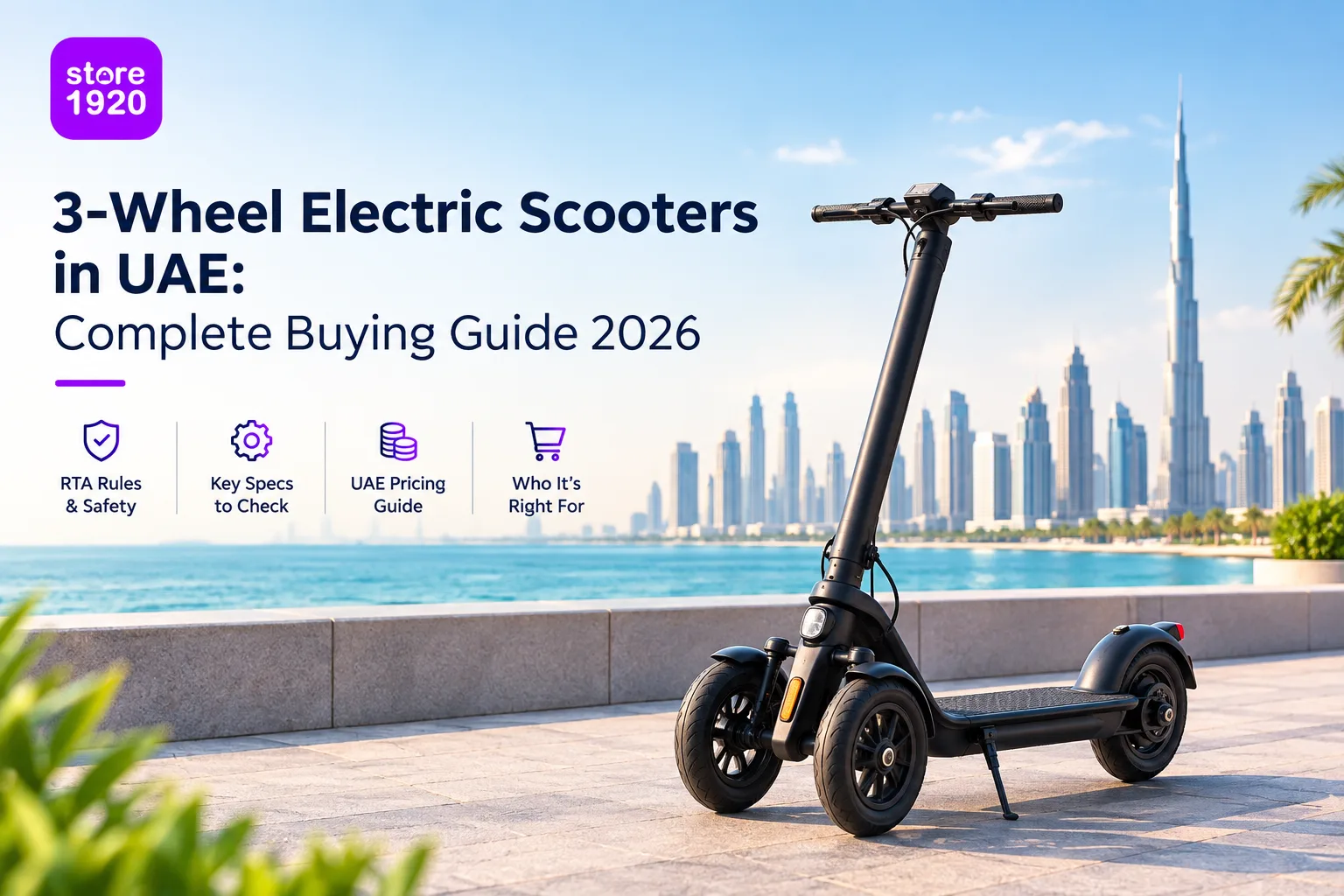
3-wheel electric scooters have moved from a niche accessory to one of the fastest-growing categories in UAE personal mobility, and most buyers still aren't sure what they're actually paying for beyond "extra stability."
That phrase gets repeated on nearly every product page, but it doesn't tell you why the stability matters, what it changes about how you ride in Dubai traffic, or whether it's worth the price gap over a standard two-wheeler.
This guide breaks that down properly. It covers what a 3-wheel electric scooter does differently at a mechanical level, the RTA rules that apply whether you're riding two wheels or three, realistic UAE pricing, and the exact specs worth checking before you buy — including where cheaper listings quietly cut corners.
What Makes a 3-Wheel Electric Scooter Different
A standard electric scooter balances on two wheels in a straight line, the same way a bicycle does. A 3-wheel electric scooter changes that geometry: most commonly, two wheels sit at the front (or occasionally the rear), and the deck is supported on three points rather than balanced on a line.
You don't need to actively balance the scooter at a standstill or at low speed — it simply stays upright.
That matters in a few everyday situations riders in the UAE run into constantly:
Starting and stopping in traffic. A two-wheeler wobbles most in the first and last few seconds of a ride — exactly when you're weaving around parked cars, taxi doors, or pedestrians stepping off a curb. A 3-wheel deck stays flat through that window.
Uneven surfaces. Villa driveways, warehouse floors, unfinished pavement sections, older parts of Deira and Sharjah — three contact points shrug off camber and small potholes that would unsettle a 2-wheeler.
Carrying weight one-handed. If you're commuting with a delivery bag, a laptop case, or groceries in one hand, a 3-wheel scooter tolerates that shifted balance far better than a two-wheeler will.
The trade-off is turning radius and kerb weight. Most 3-wheelers lean into a turn rather than pivoting sharply, and they typically carry a few extra kilos from the wider axle and reinforced frame. The Mansory SM10, for instance, uses a magnesium alloy frame specifically to keep that added weight down to around 22kg.
UAE Rules That Apply to Any Electric Scooter — 2-Wheel or 3-Wheel
Before you compare models, it helps to be clear on what's actually required, because the rules apply based on how many wheels your scooter has, not whether it's a 2-wheel or 3-wheel electric scooter.
In the UAE, personal mobility devices — e-scooters, e-bikes, and bicycles included — fall under Dubai's Executive Council Resolution No. 13 of 2022, enforced jointly by the RTA and Dubai Police.
Here's what that means in practice:
Minimum age is 16, and this applies across the UAE, not just Dubai.
Speed is capped at 20 km/h in most designated riding areas and residential zones under RTA safe-street measures. A smaller number of shared tracks permit up to 25 km/h, and 20 km/h is the number to plan around for everyday riding.
Helmets are required, and RTA guidance also recommends reflective clothing, particularly for evening rides.
An RTA e-scooter permit is required for most riders — riding is restricted to designated tracks and approved residential zones rather than open roads.
No passengers. Carrying a second person on any electric scooter, regardless of wheel count, is a fine.
Technical requirements cover working front and rear lights, a horn on the handlebar, functioning brakes, and tyres suitable for local road conditions.
Enforcement has picked up noticeably. Dubai Police seized 656 electric scooters in 2024 alone for rule violations, and a dedicated e-scooter enforcement unit began operating in 2026 to focus specifically on unsafe riding.
Fines for common violations currently range from around AED 100 up to AED 300, with the higher end applied to riding on roads with speed limits above 60 km/h, carrying a passenger, or dangerous riding.
This is where the wheel-count question actually intersects with the law: extra stability doesn't exempt you from any of the above, but it does make it noticeably easier to ride predictably at the legal 20 km/h cap, since 3-wheel scooters are inherently more controlled at lower, steadier speeds — which is exactly the speed band UAE law requires you to ride in.
Who a 3-Wheel Scooter Actually Suits?
Not every rider needs the extra wheel. A 3-wheel scooter tends to make the most sense for:
First-time e-scooter riders who haven't built the balance reflexes a 2-wheeler demands.
Riders over 40–45kg lighter body types, or taller riders who found standard 2-wheel decks feel twitchy at low speed.
Anyone riding on mixed surfaces — villa compounds, warehouse or office car parks, uneven community pavement.
Commuters who need to carry a bag, laptop case, or delivery items and want a stable platform rather than a balancing act.
Riders who fold and store their scooter regularly — most 3-wheel models, including the SM10, are built with foldability as a core requirement, since the wider frame needs to compress for apartment or car-boot storage.
If you're an experienced rider who wants maximum speed or the lightest possible frame, a 2-wheel scooter will usually feel more responsive through traffic.
We cover that comparison in more depth in our companion article, 3-Wheel vs 2-Wheel Electric Scooters: Which Is Safer for UAE Roads?
What to Check Before Buying a 3-Wheel Electric Scooter
1. Motor power and top speed. Most 3-wheel commuter models on the UAE market sit between 350W and 500W, with top speeds of 20–25 km/h — comfortably inside the legal range without needing a modified or imported unit that could run afoul of speed regulations.
2. Real-world range, not just the marketing number. Manufacturers publish range figures under ideal conditions: flat ground, average rider weight, moderate temperature. In UAE heat and on inclines, expect the real figure to land toward the lower end of any quoted range.
3. Braking system. Look for dual braking — a front electronic brake (EABS) paired with a rear mechanical or hydraulic brake — rather than stopping control from a single rear brake alone, which matters more on a heavier 3-wheeler.
4. Battery capacity and charge time. A 36V battery in the 7.5Ah–10.4Ah range is standard for this category, typically charging fully in 4–6 hours.
5. Frame material and weight. Magnesium alloy frames keep 3-wheel scooters foldable and liftable despite the extra wheel, generally landing around 20–24kg — heavier than a basic 2-wheel commuter scooter, but still manageable for stairs or car storage.
6. Warranty and authorized seller status. Because 3-wheel scooters carry a higher price point, buying from an authorized dealer matters more here than with a budget 2-wheeler — it affects warranty validity, spare parts access, and after-sales support.
Electric Scooter Price in UAE: What to Actually Expect
Pricing spreads out more than most first-time buyers assume. A basic 2-wheel commuter scooter starts from roughly AED 500–800, while mid-range 2-wheelers with better batteries and suspension run AED 900–1,500.
The 3-wheel category sits above that: most 3-wheel commuter and luxury models on the UAE market fall between AED 1,500 and AED 5,000, with premium builds like the Mansory SM10 positioned toward the upper end of that range, reflecting the frame quality and branding behind them.
If you see a 3-wheel scooter priced well below AED 1,500, it's worth checking the battery spec and frame material closely — that price gap usually comes from somewhere.
Frequently Asked Questions
Are 3-wheel electric scooters legal in Dubai and the UAE?
Yes. The same rules that apply to standard electric scooters in UAE roads — minimum age 16, the RTA permit requirement, the 20 km/h speed cap, and mandatory safety equipment — apply equally to 3-wheel models. Wheel count doesn't change the legal category.
Are 3-wheel electric scooters safer than 2-wheel ones? They're more stable at low speed, at a standstill, and on uneven ground, which reduces the most common cause of new-rider falls. They don't make you immune to traffic risk or road rule violations, which is where most serious e-scooter incidents actually happen.
Do 3-wheel scooters fold the same way as 2-wheel scooters? Most current models, including the Mansory SM10, are built with foldability as a core design requirement, though the folded footprint is typically a little larger than an equivalent 2-wheel scooter because of the wider rear axle.
How much do 3-wheel electric scooters cost in the UAE? Pricing varies by brand and battery capacity, but most 3-wheel commuter and luxury models on the UAE market fall between AED 1,500 and AED 5,000, with premium builds like the Mansory SM10 positioned toward the upper end of that range for their frame quality and branding.
Do I still need a permit for a 3-wheel electric scooter? Yes — the RTA permit requirement applies based on vehicle type (electric scooter), not wheel configuration.